Friday, February 27, 2015

Friday February 27

There are 3 basic (stereotypical) risk/reward scenarios...

  1. Risk averse
  2. Risk neutral
  3. Risk seeking
In the risk averse scenario,  there is an almost instant negative effect from a behavior.
In the risk neutral scenario, risk and reward develop equally.
In the risk seeking scenario, the negative effect takes longer to develop and an individual is rewarded for increasing the risk.

If we substitute exposure and financial compensation for risk and reward we can begin to look at how our society deals with toxic exposures in the work place and exposures to citizens.

In your book, find examples of exposure/compensation events where workers or citizens are exposed (with or without their knowledge) to toxic substances and how they are compensated for that exposure.


Thursday, February 26, 2015

Thursday February 26

Look at Chapter 18 in Chiras at the section on risk aversion.  You need to (by yourself) create a risk aversion diagram (like the one below) and identify where you fit in the graph. When you have completed this, you need to post your graph on a wall and the class will go around and indicate their position on everyone else's risk graph.  At the end of class, take pictures of all of the graphs and put the pictures in a class google doc that is shared with me.

Here is the catch, one axis must be an exposure to an industry specific toxic exposure (be accurate) and the other a monetary value.  My example is happiness -vs- money. Where would you place yourself?


Wednesday, February 25, 2015

Wednesday February 25

Here is a link to a different presentation on toxicology. When you look at this presentation or the one from Monday (or in your book) you should be able to identify information about how toxins can impact human health. The categories that you need to understand and describe are:

  1. Mutations
  2. Cancer
  3. Birth Defects
  4. Reproduction
  5. Environmental Hormones
In addition to the above direct effects, you need to be able to identify potential synergistic effects of these toxins. 

You need to be able to look at the relationship between a dose response curve and LD-50 and LC-50 and how it changes when toxins are combined or compounded.

For those of you that are interested, here is a link to how the dose response curves are calculated for PCB.

Friday is a "News Friday". Please find an article about toxic exposure (read it) and be able to answer the following questions.

  1. What is the toxic chemical that is discussed in your article?
  2. What is the source of the chemical? (If the article does not mention a direct location, what industry typically uses the chemical?)
  3. What are the effects of the chemical on humans?
  4. Does the chemical behave differently in humans based on age? on sex? on physical condition?
  5. What is the LD50 for the chemical?

Monday, February 23, 2015

Tuesday February 24

Here is a link to the in-class activity. It includes the instructions for Warm-Up #4. We will work on this activity in class and you will have some time to start on #4 too! For those of you that are absent (and dutifully checking in) this assignment is due on Friday.

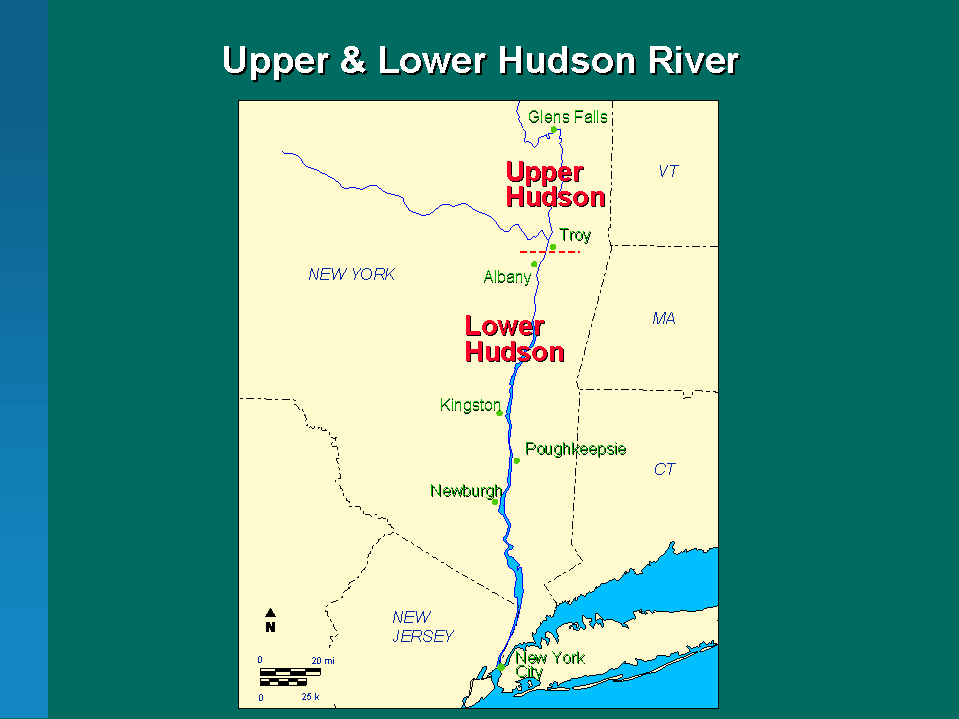
Below is a map of the Hudson River, starting in "upstate" and flowing south to NY City. This activity will focus on one type of toxin (PCB's) that have been found in the Hudson River.

  1. You will evaluate the levels of contamination.
  2. You will identify the exposure pathways for individuals in the Hudson Rv. watershed.
  3. You will identify the exposure dose(s) or individuals in the Hudson Rv. watershed.
  4. You will evaluate the effects of PCB's on individuals in the Hudson Rv. watershed.


Monday February 23

Here is the presentation for Chapter 18. I will review this material in class on Monday. Below is the reading guide. Please have this read and completed this week. Friday (2/27) is going to be an article day. Please find an article about toxic substances (within a year), read and be ready to discuss.


Chapter 18 Reading Guide
Vocabulary
  • DNA
  • PCB's
  • chromosomes
  • actual risk
  • acute effects
  • dose-response curve
  • threshold level
  • chronic effects
  • antagonism
  • asbestos
  • bioaccumulation
  • biomagnification
  • birth defect
  • cancer & carcinogen
  • tumor
  • mutation 
  • mutagen
  • synergistic response
  • tetragen
  • tradable permits
Concepts
  • Definition of toxins
  • pathways of exposure
  • categories of risk
    • cancer
    • birth defects
    • mutagens
    • endocrine disruptors
  • Measuring exposures
  • Ecosystem measures
  • Federal Response
  • Market Controls
  • Multimedia (Integrated) Pollution Management
  • Risk Assessment
  • Space-Time Valuation Models
Legislation
  • Wow- look at page 389

Thursday, February 19, 2015

Thursday February 19

Here is the log-in information for tonights game. The password (if you are asked for it) is Creek. I am on the legislation/policy google doc now. You need to set this up before we start the simulation. In addition, please make a determination what "winning" means in this scenario. Happy fishing folks!


Here is a simulation about the treatment of various surface water contaminants. Please move through the simulation and create a data table for each of the water samples. Please include the type of water, the type of pollutant, the range of pollutants and the method of treatment.This will be completed in class on Thursday.

I am available during 5th and 8th and after school from 3:00 to 4:00 to go over the test that is tomorrow (Friday).

We will run the Sloan Fishing simulation tonight from 6:00 to ????. Be sure to sign up on the google doc here.  This will be run as individuals with a collective approach to the regulation of the fishery. Here is a link to the google doc that you will use to create the legislation/regulations.

Please make sure that you pick up all of the graded warm-ups and review them. Please make sure that you register for the AP exam. It is my expectation that all of you take the AP exam in May. If you have any questions, let me know.


Here is a link to an interesting food related competition. The filing deadline is pretty quick (3/9) so we would need to have a conversation pretty quickly. Let me know your thoughts!

By the by.... I am Super Happy It's Thursday, are you?


Tuesday, February 17, 2015

Tuesday February 17

Howdy gang-
A short but busy week ahead. Here goes, the reading guide has been published and we will have some time to review that this week. After hours of playing working on the Sloan Fishing Simulation, I found that if I specify the number of permits as greater than the number of ships that you own, you will automatically buy the maximum number of ships until the two (ships and permits) are equal. This is an easy fix. I propose a Thursday afternoon/evening replay. Here is a sign-up sheet for the extra credit activity.
You have a test on Water Unit Test on Friday. I will have review sessions on Wednesday and Thursday during 5th and 8th, and after school.

Friday February 13

Chapter 21 Reading Guide


  1. There are 4 headings in this chapter
    1. Surface Water Pollution
    2. Ground Water Pollution
    3. Ocean Pollution
    4. Water Pollution Controls
  2. For each of the above sections (EXCEPT the Water Pollution Control), identify the sources of the contaminants. The sources can be broken down into the following categories
    1. Non-Point Source
    2. Background
    3. Municipal
    4. Industrial
    5. Other
  3. For each of the categories (EXCEPT the Water Pollution Control), identify the types of contaminants that result from each of the sources.
  4. For each of the contaminants, identify the effects of the contaminants on 
    1. ecosystem functions
    2. plant systems
    3. animal systems
    4. human health
Vocabulary
  1. coliform bacteria
  2. eutrophication (natural and cultural)
  3. fecal streptococcal bacteria
  4. inorganic nutrients
  5. natural succession
  6. point source pollution
  7. non-point source pollution
  8. red tide
  9. stream bed aggradation
  10. thermal shock
  11. silviculture
  12. cryptosporidium
  13. "bio-brick"
Legislation
  1. Medical Waste Tracking Act
  2. Ocean Dumping Ban Act
  3. Oil Pollution Act
  4. Plastic Pollution Control Act
  5. Clean Water Act
  6. Great Lakes Water Quality Agreement
Alphabet Soup
  1. BOD
  2. DO
  3. CWA
  4. PCB
  5. NPDES
Critical Thinking
  1. "As a general rule, each ton of materials that we throw away is preceded by 5 tons of manufactured waste and 20 tons of waste generated at the source (the mine or forest where the raw material is acquired)."
  2. "It is a crime to catch a fish in some lakes and and a miracle in others" -Evan Esar
  3. What does the presence (or absence) of particular organisms (fish and invertebrates) tell us about the amount of dissolved oxygen in an aquatic ecosystem?
  4. What relationship did you find between groundwater contamination, fracking and the availability of drinking water from aquifers?

Wednesday, February 11, 2015

Wednesday February 11

Here is the link to the Sloan Fishbank Simulation.
Click on the "Play as an individual" tab and register as firstname_lastname

  1. What is the relationship between the exponential growth of your fleet and the fishery?
  2. How long and with how many ships does it take to drive the expected catch (and the corresponding revenue) to a negative value?
  3. How long did it take the fishery to recover?
  4. From a financial perspective, where did you allocate your ships?
  5. How does the valuation of ships correspond with the value of fish harvested from the fishery?
  6. Why do the fish stocks not return after the fishery has been depleted?

Tuesday, February 10, 2015

Tuesday February 10

Fishery Science

We are going to use a (dreaded) google presentation today to begin our exploration of fishing. Your HW for tonight is listed below.

Your warm-up (#3 if you are keeping score) for this week, due on Friday...
Go to this page and select a fishery and a fish stock/species to research.

  1. What is the fishery that you selected? (region, water type and body of water)
  2. How is the species harvested? What fishing method(s) are employed?
  3. How much was harvested during a 10 year period (of your choosing)? Provide a data set and a graph showing the harvest. Include the variety of harvesting methods within your graph and data set.
  4. What laws or regulations are in place for the harvested species?
  5. What is the goal of the law/regulation?
  6. Has it worked? How can you tell?

For Homework tonight, watch this video and create a game plan for your team on Wednesday. You will not know who is on your team until Wednesday morning so you should be prepared to defend your plan from all angles.

Monday, February 9, 2015

Monday February 9

Go to this link and explore the relationship between DO, temperature and light. Please note that the quiz questions at the end of this activity are fair game for the water unit test. Here is the direct link to a simulated DO lab.

(Date of the test is TBD but we need to set it for next week....I am thinking Thursday or Friday....let me know what schedules look like, but keep in mind that we do not have class Monday or Tuesday next week.)
Use this link to evaluate the relationship between DO and BOD. Take a look at this quiz to see how well you understand these ideas.

What is DO?
What is BOD?
What are the abiotic factors that influence DO levels in aquatic ecosystems?
What are the biotic factors that influence DO levels in aquatic ecosystems?
What are the physical characteristics of an aquatic ecosystem that influence DO levels?
What are the types of aquatic ecosystems that are evaluated in this activity?
What are the testing methods to measure DO levels?


Monday, February 2, 2015

Monday February 2


  1. Contaminant Type
  2. Source of Contaminant
  3. Effects of Contaminant
Identify a contaminant from each of the listed "use sectors" and provide the above information for each. An example will be provided in class for the agricultural sector. 
The use sectors are: agriculture, residential, industry, commercial, electrical generation, run-off and refineries.