Wednesday, April 29, 2015

Friday, April 24, 2015
Friday April 24
This is where it all started.... FOX News article & video
In response....
Hank Green looks at the 10 arguments used to deny global warming and the role of humanity; a Crash Course in Ecology
Your HW for the weekend is to complete the FRQ's linked here. See you Monday!
In response....
Hank Green looks at the 10 arguments used to deny global warming and the role of humanity; a Crash Course in Ecology
Your HW for the weekend is to complete the FRQ's linked here. See you Monday!
Tuesday, April 21, 2015
Tuesday April 21
Revised Review Schedule is as follows...
Tuesday April 21 from 3-5 in W-419
Thursday April 23 meet in W-419, go to CC State Park
Tuesday April 29 from 3-5
Wednesday April 30 from 3-5 in W-419
Saturday May 2 from 8-12 meet in W-419, go to CC State Park
Review Topics in class today...
Tuesday April 21 from 3-5 in W-419
Thursday April 23 meet in W-419, go to CC State Park
Tuesday April 29 from 3-5
Wednesday April 30 from 3-5 in W-419
Saturday May 2 from 8-12 meet in W-419, go to CC State Park
Review Topics in class today...
- biotic and abiotic factors that influence freshwater aquatic ecosystems
- pH
- temperature
- nitrates/phosphates
- turbidity
- DO
- BOD
- indicator species for freshwater aquatic ecosystems
- renewable versus non-renewable resources
- sustainability
- economic incentives/disincentives to resource use
- criteria contaminants regulated by the US EPA
- sources of contaminants
- health effects of contaminants
- levels of contaminants
Monday, April 20, 2015
Monday April 20
Here is a great article (mostly a great graph) about the role of volcanic activity in relation to atmospheric carbon levels.
In class today:
In class today:
- We will work through the 1999 FRQ section of the APES exam. We will review the material on Tuesday.
Friday, April 10, 2015
Friday April 10
Take a look at this video and try to determine what pattern(s) that you can see.
You will be divided into 5 groups with the following topics...
Group # Topic
1 Normal
2 El-Nino
3 La-Nina
4 Weather effects of El-Nino
5 Weather effects of La-Nina
The purpose of these groups is to research the topic and the present to class (in a shareable electronic format) the information that you have found. Your electronic presentation should include
You will be divided into 5 groups with the following topics...
Group # Topic
1 Normal
2 El-Nino
3 La-Nina
4 Weather effects of El-Nino
5 Weather effects of La-Nina
The purpose of these groups is to research the topic and the present to class (in a shareable electronic format) the information that you have found. Your electronic presentation should include
- important vocabulary including weather related terms
- diagrams/maps
- an explanation for the movement of masses of hot and cold materials
- an explanation for the cyclical nature of your topic
- a summary of your topic
From the PhET...
- How does visible light behave when interacting with greenhouse gases? other atmospheric gases?
- How does infrared light behave when interacting with greenhouse gases? other atmospheric gases?
- What is the range of concentration of carbon dioxide between the last ice age and today?
- Over what period of time did the concentration change and by how much during that time?
- What event(s) might have occurred during this time frame that could explain the changing concentrations?
- Is there a correlation or causation between carbon dioxide concentrations and temperature? Explain.
Thursday, April 9, 2015
Wednesday April 8
The purpose of the activity today is to determine whether the relationship between carbon dioxide and temperature is corollary or causal. We are evaluating the data in the graph below from NOAA. (The link is provided)

To that end, you will use this simulation and answer these questions.
To that end, you will use this simulation and answer these questions.
Tuesday, April 7, 2015
Tuesday April 7
Exam Review Schedule
Tuesday April 21 from 3-5 in W-419
Saturday April 25 from 8-10 (AM) in W-419
Monday April 27 from 3-5 in W-419
Wednesday April 29 from 3-5 in W-419
Warm-Up #6-2
Tuesday April 21 from 3-5 in W-419
Saturday April 25 from 8-10 (AM) in W-419
Monday April 27 from 3-5 in W-419
Wednesday April 29 from 3-5 in W-419
Warm-Up #6-2
- What is the origin of Earth Day?
- Provide the dates, names, places and momentous events that brought this into being.
- What is your Earth Day pledge?
- What are you going to do differently on that day to mark the occasion.
- Think about all that you have learned this year and find a way to put that education into action (even if it is only one day!)
Monday, April 6, 2015
Monday April 6
Use the graph below to evaluate causation and correlation.


Reading Guides for Chapter 19 & 20: Global Climate Change & Atmospheric Mechanics
Chapter 19: EPA Criteria Pollutants
- What is causation?
- What is correlation?
- Is there causation or correlation in the graph below? Why?
Reading Guides for Chapter 19 & 20: Global Climate Change & Atmospheric Mechanics
Chapter 19: EPA Criteria Pollutants
- CO
- NOx
- SOx
- PM
- VOC
For each of the above,
- What are the natural and anthropogenic sources of each?
- What are the effects of each on
- human health?
- ecosystem function?
- building materials?
- What legislation has been enacted to counter the release of these materials?
- What pollution control technologies have been created (installed) to control the emissions?
- How are the elements found in fossil fuels related to the above?
- What causes the "brown cloud" here in Denver? (Refer to the diagram on page 408 and the discussion on 407-408).
- What is the "forgotten" pollutant?
- How is it regulated?
- What are the effects of exposure?
Tuesday, March 24, 2015
Wednesday March 25
Use this website to complete the refinery diagram worksheet. Be sure to look at the relationship between temperature, pressure and the length of the hydrocarbon chain. Be sure to hit the "forward"button for each of the refined products to see what they are used for.
In order to use the "cradle to grave" approach for oil, you need to know:
Review this video in order to use the "cradle to grave" approach for coal, you should be able to answer the following:
In order to use the "cradle to grave" approach for oil, you need to know:
- the source material;
- the extraction process;
- what each of the refined products are made of (elements);
- the energy inputs of the refining process;
- the sector of use;
- the result of use (combustion products for example).
Review this video in order to use the "cradle to grave" approach for coal, you should be able to answer the following:
- the source material;
- the extraction process (mining);
- the 4 types of coal;
- what is coal used for/the sector of use;
- the result of use (finished products for example).
Check out this website. It illustrates from extraction to burner, the story of natural gas. Be sure to take the quiz at the end of your tour (lower left of the list) to see how you score compared to the national average. As before, check out the following
- the source materials;
- the extraction process and/or the conversion processes;
- what each of the refined products are made of (elements);
- the energy inputs of the refining/conversion process;
- the sector of use;
- the result of use (combustion products for example).
For all of the above fossil fuels,
- what do you think about the way that these materials are being used?
- Are they highly specialized or can they be used for multiple applications?
- Does the level of specialization make them more or less valuable?
- List the ways that you have interacted with each of the resources so far today.
Thursday, March 19, 2015
Thursday March 19
APES Energy Problems
1. How much energy, in kJ,
does a 75 Watt light bulb use then it is turned on for 25 minutes?
2. The Kilowatt Hour, or kWh,
is not a unit of power but of energy.
Notice that kilowatt is a unit of power and hour is a unit of time. E = P x t (rearranged from above). A kilowatt hour is equal to 1 kW delivered continuously for
1 hour (3600 sec).
Assume your electric bill
showed you used 1355 kWh over a 30-day period.
a.)
Find the energy used, in kJ, for the 30 day period.
b.)
Find the energy used in J/day.
c)
At the rate of $.0749/kwh, what will your electric bill be for this month?
3. A 100 Watt light bulb is 20% efficient.
a.)
How much energy does it use in 12 hours of operation?
b.)
How much energy does the bulb convert to light during 12 hours?
4. An electric clothes dryer
has a power rating of 4000 W.
Assume a family does 5 loads of laundry each week for 4 weeks. Assume each dryer load takes 1 hour.
b.) Find the
operating cost for 4 weeks. Assume
cost is $.0758/kWh
5. Refrigeration is costly in
terms of energy usage. A
single-door, manual defrost refrigerator uses 600 kilowatt hours/year
(abbreviated kWh/yr). A large, 20
cu ft two-door automatic defrost refrigerator uses 1880 kWh/yr. How many kcal/yr do each type of
refrigerator use? 1kWh = 860kcal.
6. Assume you use an air
conditioner for a total of 137 days, 24 hours per day, at a rate of 7.25 kWh
per hour. Assume the cost per kWh
is $.0825 and 1 kWh = 3400 BTUs.
a.)
Calculate the total number of kWh used per year.
b.)
Determine the cost of air conditioning for one year.
c.)
How many kcal are used per year?
d.)
How many BTUs are used in one year?
7. Suppose your electric lights
use 400 watts per hour and average four hours per day, every day for one year.
b.) If replacing the lights with a fluorescent bulb
would save 60 w per night, what savings in kWh does this represent in one year?
c.) If the fluorescent bulb costs $18 but lasts for 10
years, would you consider it a wise investment over incandescent bulbs? Explain your answer.
8. Transportation energy is
costly.
a.) Calculate the
gallons of gas use just for going to the supermarket in one year if you take 5
trips to the store per week, traveling 7.5 miles roundtrip, and your car gets
22 miles per gallon.
b.) Convert the
gallons to kcal/year if there are 32000 kcal per gallon.
c.)
What are some of the other energy uses associated with getting foodstuffs to
the consumer other than transportation costs?
d.)
What suggestions would you make to the “average American” to help save energy
and money relating to the answers you gave in C?
9. (This question is
extracted word for word from the 1998 APES exam) The environmental impact of washing a load of dirty dishes
in an electric dishwasher differs from that of washing them by hand in a
sink. Use the information and data
below to answer thee questions that follow. Show your calculations.
Assume:
i.
The dishes all
fit in one load.
ii.
The water coming
into the water heater for the sink and into the water heater in the dishwasher
is at 50o F.
iii.
The water heaters
for the sink and the dishwasher are both 100% efficient.
iv.
In one complete
cycle, the electric dishwasher uses 10 gallons of water heated to 140o
F and the dishwasher also uses 0.500 kWh of electrical energy for its
mechanical operation.
v.
Washing the
dishes by hand requires 20 gallons of water heated to 110o F.
Other Information:
1 gallon of water =
8 lb. water
1 BTU = the amount
of energy needed to raise the temperature of 1 pound of water by 1o F.
1 kWh = 3400 BTUs.
a. Calculate the total energy
(in BTU’s) used both to heat the water and run the electric dishwasher to wash
a load of dishes.
c. Discuss the economic and
environmental costs and benefits of
i. using the
electric dishwasher (including its manufacture and disposal)
ii. washing the
dishes by hand
Wednesday, March 18, 2015
Wednesday March 18
In-class, complete the energy primer handout, excluding question 8a -8c. You need to make note that the combustion of 1 gallon of gasoline releases 18.5 pounds of carbon dioxide in order to answer the remainder of question 8 (d-g).
Be sure to complete the reading guide for Chapters 14 & 15.
Use this website. Be prepared to discuss in class on Friday the following:
- What needs to be done to meet each of the goals?
- What type of community would work best for a case study?
- What recommendations would you make for the CCHS community?
- What recommendations would you make for the GWV community?
- Why not?
Warm-Up #5-2 This is due on Friday 3/20
- What is OPEC?
- what does OPEC stand for?
- who are the OPEC member nations?
- what is the goal of OPEC?
- what is a production level?
- what is the current production level established for each OPEC nation?
- Use this website to look at current OPEC production values
- Click on the 2002 PDF, go to page 36 and create a table for the proven reserves of OPEC member nations for the 5 year period 1998-2002.
- Click on the 2014 PDF, go to page 22 and create a table for the proven reserves of OPEC member nations for the 5 year period 2009-2013.
- What trends do you notice?
- How can you explain your observations?
- How does this information relate to the current OPEC production levels?
Chapter 15 Reading Guide
- What does the term renewable energy mean?
- What does the term traditional energy mean?
- What does the term alternative energy mean?
- How do the above terms differ?
- How does conservation and efficiency relate to the use and availability of energy sources?
- How is energy efficiency encouraged by the US federal government?
- How is energy efficiency discouraged by governments other than the US?
- In developed countries, what are the sectors of energy use? (For what purposes do you use energy?
- Create a list of the renewable energy sources discussed in this chapter.
- Where does the energy come from?
- What are the advantages of the renewable compared with traditional sources?
- What are the disadvantages of the renewable compared with traditional sources?
- Provide a comparison of costs.
- How many different ways can energy from the Sun be utilized?
- Why is this relevant in Colorado?
- How do solar panels generate electricity?
- How do hydrogen fuel cells generate electricity?
- On page 322, the photo labeled "b" shows a drum filled with water.
- What is the significance of the water in the drum?
- Read the case study on page 316.
- What is the hyper car?
- What is a hybrid car?
- What is a plug-in hybrid?
- How do hybrid cars work?
- How do plug-in hybrid cars work?
- What is the relationship between the warm-up this week and the hyper car?
Monday, March 16, 2015
Thursday March 12
The Free Response
How do you approach an FRQ that you have never seen before? With calm confidence!
Review the FRQ handout provided in class. Be sure to use dimensional analysis to answer the questions. One of the best approaches to evaluating metals is to think about intended uses. Here is a list of the types of metals found in batteries. When you have completed the activity, use the scoring guide to evaluate how you did.
How do you approach an FRQ that you have never seen before? With calm confidence!
Review the FRQ handout provided in class. Be sure to use dimensional analysis to answer the questions. One of the best approaches to evaluating metals is to think about intended uses. Here is a list of the types of metals found in batteries. When you have completed the activity, use the scoring guide to evaluate how you did.
Friday March 13
Energy Unit
Reading Guide for Chapter 14
Non-Renewable Resources:
For each of the above,
Reading Guide for Chapter 14
Non-Renewable Resources:
- coal
- oil (petroleum)
- natural gas
- nuclear
For each of the above,
- where do the resources come from?
- how are the resources extracted?
- how are the resources transported from point of extraction to point of use?
- what are the issues associated with the transportation of the resource?
- how are the resources prepared for use?
- what are the resources used for?
- how are the resources disposed of?
- what are the effects of resource disposal on
- the atmosphere?
- aquatic ecosystems?
- terrestrial ecosystems?
- human health?
- what are the geo-political ramifications of resource acquisition and use?
- what is the timeline for the past and future use of the resource?
- what legislation governs the
- extraction
- processing
- transportation
- use/disposal
Warm-Up #5-2 (This is due on Friday 3/20, along with an article about one of the resources discussed in this chapter...
- What is OPEC?
- what does OPEC stand for?
- who are the OPEC member nations?
- what is the goal of OPEC?
- what is a production level?
- what is the current production level established for each OPEC nation?
- Use this website to look at current OPEC production values
- Click on the 2002 PDF, go to page 46 and create a table for the proven reserves of OPEC member nations for the 5 year period 1998-2002.
- Click on the 2014 PDF, go to page 22 and create a table for the proven reserves of OPEC member nations for the 5 year period 2009-2013.
- What trends do you notice?
- How can you explain your observations?
- How does this information relate to the current OPEC production levels?
Monday March 16
Here is an "energy primer" for you to review. I will provide a worksheet (FRQ-dimensional analysis) for you on Wednesday that is due on Friday.
As a reminder, I am available to review the last unit test and begin to prepare for the EXAM tomorrow. I will be in my room (or in the greenhouse if you can't find me) for help. Be proactive and use these days to your (our) advantage.
As a reminder, I am available to review the last unit test and begin to prepare for the EXAM tomorrow. I will be in my room (or in the greenhouse if you can't find me) for help. Be proactive and use these days to your (our) advantage.
Tuesday, March 10, 2015
Wednesday March 11
Use this presentation to review chapter 23 (Solid Waste Disposal) and answer the questions below.
Here is a bank of questions that you can use to review for the test on Friday. Please remember that there will be an FRQ that deals directly with dimensional analysis. The composition of the test is 25 MCQ and 2 FRQ.
Here is a nice little study diversion activity. Let me know what your high score is!
- What are the types of waste streams?
- What type of waste represents the largest percentage of solid waste (by weight) generated in the US?
- What are the disposal options for the different streams?
- Why is the "throughput" or "cradle to grave" approach to waste disposal important?
- What are the factors that contribute to the use of a particular waste disposal option?
- Why is product/material design and substitution an important component of waste disposal?
- What is an economic externality? Provide an example of an economic externality described in the presentation or in the book.
- List and define all of the pieces of legislation that are listed in this chapter.
- What are UST's? What are they used for? What is the environmental issue with them?
Here is a bank of questions that you can use to review for the test on Friday. Please remember that there will be an FRQ that deals directly with dimensional analysis. The composition of the test is 25 MCQ and 2 FRQ.
Here is a nice little study diversion activity. Let me know what your high score is!
Monday, March 9, 2015
Friday March 6
Find an article about a toxic exposure/leak....
- What is the toxin?
- What exposure pathway was discussed?
- What length of exposure occurred?
- What body systems or organs are impacted?
- How are the body systems or organs impacted?
Thursday, March 5, 2015
Thursday March 5
The Lessons of Love Canal
- Corporate Ownership
- Property Transfers (buying & selling)
- Laws
- RCRA
- CERCLA
- Superfund
- Cradle to Grave
Tuesday, March 3, 2015
Wednesday March 4
Be sure to complete the Love Canal assignment from yesterday. We will be talking (to each other) in class tomorrow about stakeholders and the progression of the Love Canal event. The 23 study guide is set and is heavy on Love Canal, use it to help prepare for tomorrow.
Chapter 23 Reading Guide
Vocabulary:
aseptic container
input approach
output approach
source reduction
land disposal
municipal solid waste
sanitary landfill (lined landfill)
secured landfill
landfill
waste reduction strategies
recycling
composting
decomposition (high and low temperature; aerobic and anaerobic)
Alphabet Soup:
CERCLA
RCRA
WTE
NIMBY
Legislation:
Superfund Act
CERCLA
RCRA
Marine Protection, Research and Sanctuaries Act
Nuclear Waste Policy Act
Ocean Dumping Ban Act
Concepts & Big Ideas
Love Canal
Chapter 23 Reading Guide
Vocabulary:
aseptic container
input approach
output approach
source reduction
land disposal
municipal solid waste
sanitary landfill (lined landfill)
secured landfill
landfill
waste reduction strategies
recycling
composting
decomposition (high and low temperature; aerobic and anaerobic)
Alphabet Soup:
CERCLA
RCRA
WTE
NIMBY
Legislation:
Superfund Act
CERCLA
RCRA
Marine Protection, Research and Sanctuaries Act
Nuclear Waste Policy Act
Ocean Dumping Ban Act
Concepts & Big Ideas
Love Canal
Tuesday March 3
I am feeling a bit philosophical about the education system after a couple of conversations with you. One of the ideas that was discussed was this article that bemoans (once again) the state of the US education system. There are some issues (in the article) that I want to address with this activity. First off, pay attention to the bold, underlined terms in the questions below. Focus on those terms as you answer the questions. This is not about right and wrong, this is about you thinking and reasoning. It is about you using the information that you possess to reason and make decisions.
Here is the introductory video that I want you to watch. The Love Canal Tragedy is a case study in the use and disposal of the chemicals that are a cornerstone of our quality and way of life. Here is a presentation done by Michigan Tech about Love Canal. It lists the chemicals and provides an interesting perspective on the event.
The Love Canal Tragedy
Here is the introductory video that I want you to watch. The Love Canal Tragedy is a case study in the use and disposal of the chemicals that are a cornerstone of our quality and way of life. Here is a presentation done by Michigan Tech about Love Canal. It lists the chemicals and provides an interesting perspective on the event.
- What are the important pieces of information that you think you should know about the Love Canal Tragedy?
- Why do you think that this information is important to understand the relationship between environmental protection laws and Love Canal?
- Identify the stakeholders involved in this event.
- Ascribe moral, financial and economic responsibility as you see fit;
- Which groups are blameless in this event?
- Of the toxins that have been identified, find one that fits each of the following criteria (without repeating or using the same chemical for multiple categories).
- Mutagens (Genetic)
- Carcinogens (Cancer)
- Teratogens (Reproduction)
- Endocrine Disruptors (Hormones)
- To improve your ability to visualize this event, create a timeline (or graphic organizer) that allows you to sequence the events.
Friday, February 27, 2015
Friday February 27
There are 3 basic (stereotypical) risk/reward scenarios...


- Risk averse
- Risk neutral
- Risk seeking
In the risk averse scenario, there is an almost instant negative effect from a behavior.
In the risk neutral scenario, risk and reward develop equally.
In the risk seeking scenario, the negative effect takes longer to develop and an individual is rewarded for increasing the risk.
If we substitute exposure and financial compensation for risk and reward we can begin to look at how our society deals with toxic exposures in the work place and exposures to citizens.
In your book, find examples of exposure/compensation events where workers or citizens are exposed (with or without their knowledge) to toxic substances and how they are compensated for that exposure.
Thursday, February 26, 2015
Thursday February 26
Look at Chapter 18 in Chiras at the section on risk aversion. You need to (by yourself) create a risk aversion diagram (like the one below) and identify where you fit in the graph. When you have completed this, you need to post your graph on a wall and the class will go around and indicate their position on everyone else's risk graph. At the end of class, take pictures of all of the graphs and put the pictures in a class google doc that is shared with me.
Here is the catch, one axis must be an exposure to an industry specific toxic exposure (be accurate) and the other a monetary value. My example is happiness -vs- money. Where would you place yourself?

Here is the catch, one axis must be an exposure to an industry specific toxic exposure (be accurate) and the other a monetary value. My example is happiness -vs- money. Where would you place yourself?
Wednesday, February 25, 2015
Wednesday February 25
Here is a link to a different presentation on toxicology. When you look at this presentation or the one from Monday (or in your book) you should be able to identify information about how toxins can impact human health. The categories that you need to understand and describe are:
- Mutations
- Cancer
- Birth Defects
- Reproduction
- Environmental Hormones
In addition to the above direct effects, you need to be able to identify potential synergistic effects of these toxins.
You need to be able to look at the relationship between a dose response curve and LD-50 and LC-50 and how it changes when toxins are combined or compounded.
For those of you that are interested, here is a link to how the dose response curves are calculated for PCB.
Friday is a "News Friday". Please find an article about toxic exposure (read it) and be able to answer the following questions.
For those of you that are interested, here is a link to how the dose response curves are calculated for PCB.
Friday is a "News Friday". Please find an article about toxic exposure (read it) and be able to answer the following questions.
- What is the toxic chemical that is discussed in your article?
- What is the source of the chemical? (If the article does not mention a direct location, what industry typically uses the chemical?)
- What are the effects of the chemical on humans?
- Does the chemical behave differently in humans based on age? on sex? on physical condition?
- What is the LD50 for the chemical?
Monday, February 23, 2015
Tuesday February 24
Here is a link to the in-class activity. It includes the instructions for Warm-Up #4. We will work on this activity in class and you will have some time to start on #4 too! For those of you that are absent (and dutifully checking in) this assignment is due on Friday.
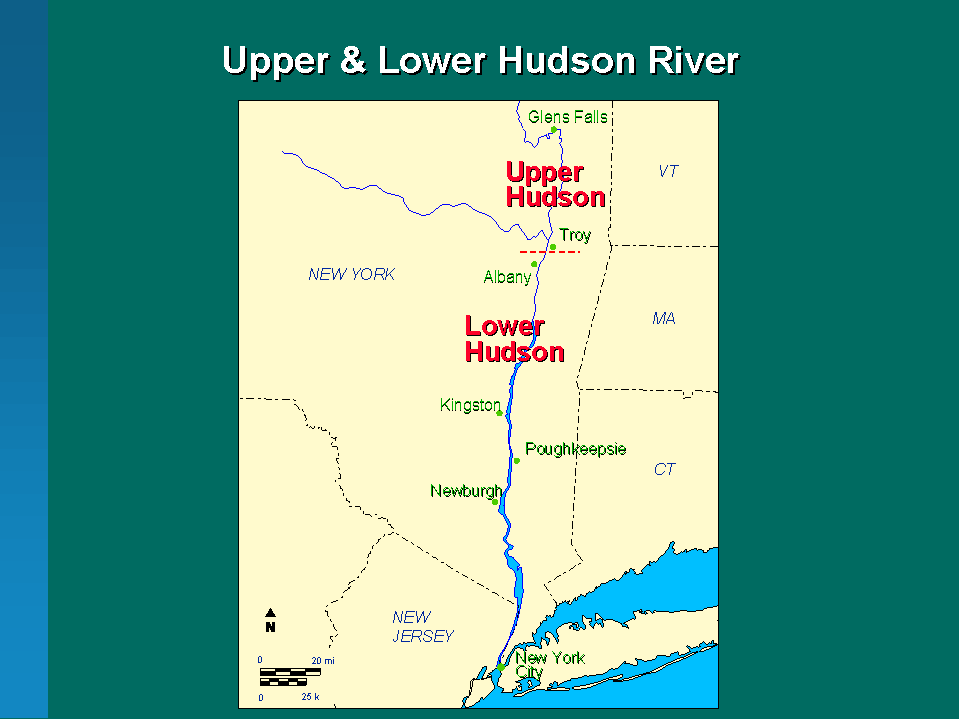
Below is a map of the Hudson River, starting in "upstate" and flowing south to NY City. This activity will focus on one type of toxin (PCB's) that have been found in the Hudson River.

Below is a map of the Hudson River, starting in "upstate" and flowing south to NY City. This activity will focus on one type of toxin (PCB's) that have been found in the Hudson River.
- You will evaluate the levels of contamination.
- You will identify the exposure pathways for individuals in the Hudson Rv. watershed.
- You will identify the exposure dose(s) or individuals in the Hudson Rv. watershed.
- You will evaluate the effects of PCB's on individuals in the Hudson Rv. watershed.
Monday February 23
Here is the presentation for Chapter 18. I will review this material in class on Monday. Below is the reading guide. Please have this read and completed this week. Friday (2/27) is going to be an article day. Please find an article about toxic substances (within a year), read and be ready to discuss.
Chapter 18 Reading Guide
Vocabulary
Chapter 18 Reading Guide
Vocabulary
- DNA
- PCB's
- chromosomes
- actual risk
- acute effects
- dose-response curve
- threshold level
- chronic effects
- antagonism
- asbestos
- bioaccumulation
- biomagnification
- birth defect
- cancer & carcinogen
- tumor
- mutation
- mutagen
- synergistic response
- tetragen
- tradable permits
Concepts
- Definition of toxins
- pathways of exposure
- categories of risk
- cancer
- birth defects
- mutagens
- endocrine disruptors
- Measuring exposures
- Ecosystem measures
- Federal Response
- Market Controls
- Multimedia (Integrated) Pollution Management
- Risk Assessment
- Space-Time Valuation Models
- Wow- look at page 389
Thursday, February 19, 2015
Thursday February 19
Here is the log-in information for tonights game. The password (if you are asked for it) is Creek. I am on the legislation/policy google doc now. You need to set this up before we start the simulation. In addition, please make a determination what "winning" means in this scenario. Happy fishing folks!

Here is a simulation about the treatment of various surface water contaminants. Please move through the simulation and create a data table for each of the water samples. Please include the type of water, the type of pollutant, the range of pollutants and the method of treatment.This will be completed in class on Thursday.
I am available during 5th and 8th and after school from 3:00 to 4:00 to go over the test that is tomorrow (Friday).
We will run the Sloan Fishing simulation tonight from 6:00 to ????. Be sure to sign up on the google doc here. This will be run as individuals with a collective approach to the regulation of the fishery. Here is a link to the google doc that you will use to create the legislation/regulations.
Please make sure that you pick up all of the graded warm-ups and review them. Please make sure that you register for the AP exam. It is my expectation that all of you take the AP exam in May. If you have any questions, let me know.
Here is a link to an interesting food related competition. The filing deadline is pretty quick (3/9) so we would need to have a conversation pretty quickly. Let me know your thoughts!
By the by.... I am Super Happy It's Thursday, are you?
Tuesday, February 17, 2015
Tuesday February 17
Howdy gang-
A short but busy week ahead. Here goes, the reading guide has been published and we will have some time to review that this week. After hours ofplaying working on the Sloan Fishing Simulation, I found that if I specify the number of permits as greater than the number of ships that you own, you will automatically buy the maximum number of ships until the two (ships and permits) are equal. This is an easy fix. I propose a Thursday afternoon/evening replay. Here is a sign-up sheet for the extra credit activity.
You have a test on Water Unit Test on Friday. I will have review sessions on Wednesday and Thursday during 5th and 8th, and after school.
A short but busy week ahead. Here goes, the reading guide has been published and we will have some time to review that this week. After hours of
You have a test on Water Unit Test on Friday. I will have review sessions on Wednesday and Thursday during 5th and 8th, and after school.
Friday February 13
Chapter 21 Reading Guide
- There are 4 headings in this chapter
- Surface Water Pollution
- Ground Water Pollution
- Ocean Pollution
- Water Pollution Controls
- For each of the above sections (EXCEPT the Water Pollution Control), identify the sources of the contaminants. The sources can be broken down into the following categories
- Non-Point Source
- Background
- Municipal
- Industrial
- Other
- For each of the categories (EXCEPT the Water Pollution Control), identify the types of contaminants that result from each of the sources.
- For each of the contaminants, identify the effects of the contaminants on
- ecosystem functions
- plant systems
- animal systems
- human health
Vocabulary
- coliform bacteria
- eutrophication (natural and cultural)
- fecal streptococcal bacteria
- inorganic nutrients
- natural succession
- point source pollution
- non-point source pollution
- red tide
- stream bed aggradation
- thermal shock
- silviculture
- cryptosporidium
- "bio-brick"
Legislation
- Medical Waste Tracking Act
- Ocean Dumping Ban Act
- Oil Pollution Act
- Plastic Pollution Control Act
- Clean Water Act
- Great Lakes Water Quality Agreement
Alphabet Soup
- BOD
- DO
- CWA
- PCB
- NPDES
Critical Thinking
- "As a general rule, each ton of materials that we throw away is preceded by 5 tons of manufactured waste and 20 tons of waste generated at the source (the mine or forest where the raw material is acquired)."
- "It is a crime to catch a fish in some lakes and and a miracle in others" -Evan Esar
- What does the presence (or absence) of particular organisms (fish and invertebrates) tell us about the amount of dissolved oxygen in an aquatic ecosystem?
- What relationship did you find between groundwater contamination, fracking and the availability of drinking water from aquifers?
Wednesday, February 11, 2015
Wednesday February 11
Here is the link to the Sloan Fishbank Simulation.
Click on the "Play as an individual" tab and register as firstname_lastname
Click on the "Play as an individual" tab and register as firstname_lastname
- What is the relationship between the exponential growth of your fleet and the fishery?
- How long and with how many ships does it take to drive the expected catch (and the corresponding revenue) to a negative value?
- How long did it take the fishery to recover?
- From a financial perspective, where did you allocate your ships?
- How does the valuation of ships correspond with the value of fish harvested from the fishery?
- Why do the fish stocks not return after the fishery has been depleted?
Tuesday, February 10, 2015
Tuesday February 10
Fishery Science
We are going to use a (dreaded) google presentation today to begin our exploration of fishing. Your HW for tonight is listed below.
Your warm-up (#3 if you are keeping score) for this week, due on Friday...
For Homework tonight, watch this video and create a game plan for your team on Wednesday. You will not know who is on your team until Wednesday morning so you should be prepared to defend your plan from all angles.
We are going to use a (dreaded) google presentation today to begin our exploration of fishing. Your HW for tonight is listed below.
Your warm-up (#3 if you are keeping score) for this week, due on Friday...
Go to this page and select a fishery and a fish stock/species to research.
- What is the fishery that you selected? (region, water type and body of water)
- How is the species harvested? What fishing method(s) are employed?
- How much was harvested during a 10 year period (of your choosing)? Provide a data set and a graph showing the harvest. Include the variety of harvesting methods within your graph and data set.
- What laws or regulations are in place for the harvested species?
- What is the goal of the law/regulation?
- Has it worked? How can you tell?
For Homework tonight, watch this video and create a game plan for your team on Wednesday. You will not know who is on your team until Wednesday morning so you should be prepared to defend your plan from all angles.
Monday, February 9, 2015
Monday February 9
Go to this link and explore the relationship between DO, temperature and light. Please note that the quiz questions at the end of this activity are fair game for the water unit test. Here is the direct link to a simulated DO lab.
(Date of the test is TBD but we need to set it for next week....I am thinking Thursday or Friday....let me know what schedules look like, but keep in mind that we do not have class Monday or Tuesday next week.)
Use this link to evaluate the relationship between DO and BOD. Take a look at this quiz to see how well you understand these ideas.
What is DO?
What is BOD?
What are the abiotic factors that influence DO levels in aquatic ecosystems?
What are the biotic factors that influence DO levels in aquatic ecosystems?
What are the physical characteristics of an aquatic ecosystem that influence DO levels?
What are the types of aquatic ecosystems that are evaluated in this activity?
What are the testing methods to measure DO levels?
(Date of the test is TBD but we need to set it for next week....I am thinking Thursday or Friday....let me know what schedules look like, but keep in mind that we do not have class Monday or Tuesday next week.)
Use this link to evaluate the relationship between DO and BOD. Take a look at this quiz to see how well you understand these ideas.
What is DO?
What is BOD?
What are the abiotic factors that influence DO levels in aquatic ecosystems?
What are the biotic factors that influence DO levels in aquatic ecosystems?
What are the physical characteristics of an aquatic ecosystem that influence DO levels?
What are the types of aquatic ecosystems that are evaluated in this activity?
What are the testing methods to measure DO levels?
Monday, February 2, 2015
Monday February 2
- Contaminant Type
- Source of Contaminant
- Effects of Contaminant
Identify a contaminant from each of the listed "use sectors" and provide the above information for each. An example will be provided in class for the agricultural sector.
The use sectors are: agriculture, residential, industry, commercial, electrical generation, run-off and refineries.
Friday, January 30, 2015
Friday January 30
Fracking Video
Article Discussions & Important Talking Points
Article Discussions & Important Talking Points
- What is the watershed that is impacted in your article?
- What are the criteria contaminants mentioned in your article?
- What is the role of government (think proactive versus reactive) in protecting commons?
- Consider the role of environmental protection measures and the Olympic Games.
Warm-Up #2-2: DUE ON MONDAY February 2
Read and review the following:
- NY Fracking Facts
- PA Fracking Information
- Fracking Locations
- Here is a song that discusses the issue.
- Make a prediction about the body of water that will become the "poster child" for fracking in the future.
- What is the watershed?
- Why did you select this location?
- What do you think will be the type of pollution (criteria contaminant)?
Wednesday, January 28, 2015
Wednesday January 28
Review this introduction to the Colorado River Watershed.
Here is a 3-page summary of the 1922 Colorado River Compact.
Here is a discussion of the current California drought.
Questions that will be addressed today....
What is a watershed?
Why approach water quality at a watershed "level"?
How is water quality regulated?
What are the sources of water pollution?
What is a point source?
What is a non-point source?
Why (How) does air pollution factor into water pollution?
Who regulates water quality? (and with what regulatory policy?)
Here is a 3-page summary of the 1922 Colorado River Compact.
Here is a discussion of the current California drought.
Questions that will be addressed today....
What is a watershed?
Why approach water quality at a watershed "level"?
How is water quality regulated?
What are the sources of water pollution?
What is a point source?
What is a non-point source?
Why (How) does air pollution factor into water pollution?
Who regulates water quality? (and with what regulatory policy?)
Friday, January 23, 2015
Friday January 23
Your 1st Semester 2 Warm-Up! We shall call this Warm-Up 2-1. Please respond to the following. Please have it typed up and turned in by TUESDAY 1/27.
- Multiple dams have been erected along the Colorado River. Identify TWO benefits other than agriculture and recreation that people derive from that system of dams.
- Discuss TWO potential environmental consequences of damming a major river.
- Competition for access to Colorado River water has increased dramatically due to increased population size and intensive agricultural use. Describe TWO conservation strategies for reducing agricultural water consumption.
Monday January 26
Here is a video about the water issues in the southwestern United States. I would like you to watch the video and use it prepare a synopsis of water use equality from the Colorado River.
- What is the current basis for the distribution of water?
- What "groups" can you identify that are drawing water from the Colorado?
- What rights do each of these groups have? Are their rights that are lacking or unfair?
- What do you think should be done to plan for potential decreases in water availability?
- What group do you identify with? Why? What specific changes to water use policy would you support for this group?
Thursday, January 22, 2015
Thursday January 22
- Dimensional Analysis (Drop by Drop) (APES FRQ)
- The Chemistry of Water
- Properties
- Polarity
- Solvent
- Bonding
- The Biology of Water
- Cellular Properties
- Origins of Life
- Uses
- Residential
- Commercial
- Agricultural
- Electrical Generation
- Types
- Salt Water
- Fresh Water
- Lakes/Ponds
- Rivers/Creeks
- Ice/Glaciers
- Aquifers
- Groundwater (Soil Moisture)
- Wetland
- Issues
- Aquifer Depletion
- Freshwater Contamination
- Saltwater Intrusion
- Sinkhole
- Wetland Loss
- Desalinization
- Flooding
- Water Shortages
Wednesday, January 21, 2015
Wednesday January 21
Three Questions from Tuesday
Water (Mis)Use:
- Question #1
- When is water renewable?
- What conditions make it un-renewable?
- What condition make it renewable?
- Question #2
- What is the relationship between the creation of dams and reservoirs on rivers as it relates to flood control and droughts?
- What are the impacts of dams on rivers (in terms of habitat alteration)?
- Question #3
- Where are the headwaters of the Colorado River?
- What is the source of the water that is in the Colorado River?
- Which states have claims on that water?
- What happens if there is a decrease in the water available?
Here is a great link to Colorado water issues.
Water (Mis)Use:
- Complete the in-class assignment ("Water Loss, Drop by Drop"). This is a real good dimensional analysis problem that illustrates how easily water is "lost". -due at the end of class today (1/21)
- Go to the Water Footprint Calculator and determine the amount of water that you use. - due at the end of class today (1/21)
- Review the homework assignment ("Water Use Inventory") -due at the end of class on Monday 1/27 (which will be a work day for you).
Tuesday, January 20, 2015
Tuesday January 20
Next-up: Water
Here is the reading guide for chapter 13. Please note that 2 (two) edits were made to section #4 (#1 quality was removed and #5 was changed from protection to conservation.
Concepts:
Here is the reading guide for chapter 13. Please note that 2 (two) edits were made to section #4 (#1 quality was removed and #5 was changed from protection to conservation.
Concepts:
- hydrological cycle
- water on Earth
- where is it?
- what form is it in?
- what's in it?
- how do we get to it?
- supply and demand issues
- supply sources
- demand uses
- managing, measuring & monitoring water
- watershed
- flow
- precipitation
- use
- conservation
Legislation:
- Coastal Barrier Resources Act
- Coastal Zone Management Act
- National Wildlife Refuge System
- Watershed Protection and Flood Prevention Act
- Wetlands Reserve Program
- Wild and Scenic Rivers Act
Questions
Discuss the following...
- Water is a renewable resource, therefore we can't run out.
- How are the issues of flooding and water shortage related? How can these issues be solved with one action?
- Diagram the Colorado River using this map. What states does it flow through? Who has rights to the water? Where does the water come from? What is the source?
Tuesday, January 13, 2015
Final Exam Week
Please use this place to ask questions and check for interesting (and helpful) news items as you prepare for the exam!
Here is a BBC article about IPM!
Here is a WSJ article about the impact of OPEC pricing on Canadian Oil.
Here is a BBC article about IPM!
Here is a WSJ article about the impact of OPEC pricing on Canadian Oil.
Wednesday, January 7, 2015
Wednesday January 7
To complete our discussion on the development and use of renewable energy resources, and begin the examination of the impacts that economics and policy play we need to examine a past example of how public behavior and private enterprise interact.
The California Air Resources Board (ARB) was tasked with cleaning up the polluted air in California. As early as 1963, this group identified vehicle exhaust as a contributing factor to pollution. At the time, California had a population below 20 million (with less than 12 million registered drivers). This represented (and still does) a large consumer group.
In 1975, auto manufacturers were required to include a catalytic converter on cars sold in California. Because California represented such a large market, the effect of this legislation was that all cars sold in the USA had catalytic converters.
Yesterday, the Governor of California (Jerry Brown) announced new plans for electrical generation in California. His plan is to increase the use of renewable resources from 33% by 2020 to 50% by 2030. For comparison, Colorado has a more difficult to understand plan. Large investor owned utilities (Xcel Energy) needed to reach 12% by 2014 (they did), 20% for the 2015-2019 time period and then 30% by 2020.
I would like you to select a renewable resource and find a piece of legislation that will encourage or discourage its use.
Here is an interesting graphic that illustrates the changes that have taken place in energy production in different states during the last 20 years. This can be a starting point for you.
Tomorrow we will have a class discussion on energy policy.
The California Air Resources Board (ARB) was tasked with cleaning up the polluted air in California. As early as 1963, this group identified vehicle exhaust as a contributing factor to pollution. At the time, California had a population below 20 million (with less than 12 million registered drivers). This represented (and still does) a large consumer group.
In 1975, auto manufacturers were required to include a catalytic converter on cars sold in California. Because California represented such a large market, the effect of this legislation was that all cars sold in the USA had catalytic converters.
Yesterday, the Governor of California (Jerry Brown) announced new plans for electrical generation in California. His plan is to increase the use of renewable resources from 33% by 2020 to 50% by 2030. For comparison, Colorado has a more difficult to understand plan. Large investor owned utilities (Xcel Energy) needed to reach 12% by 2014 (they did), 20% for the 2015-2019 time period and then 30% by 2020.
I would like you to select a renewable resource and find a piece of legislation that will encourage or discourage its use.
Here is an interesting graphic that illustrates the changes that have taken place in energy production in different states during the last 20 years. This can be a starting point for you.
Tomorrow we will have a class discussion on energy policy.
Tuesday, January 6, 2015
Tuesday January 6, 2015
Here is the link to the review for the semester exam.
Here is the link to the rubric for the service based learning essay.
Define all of the resources
List all of the Resources
Development
Use
Economic Issues (associated with development and use)
Political Issues (associated with development and use)
Here is the link to the rubric for the service based learning essay.
How are/have each of the resources been developed?
Where are the resources being developed?
How are the resources used?
Where are the resources used?
Monday, January 5, 2015
Happy New Year!
January 5, 2015
Catch-up from our last meeting.... calculating pay-back periods and calculating energy consumption.
Renewable Energy Resources
Catch-up from our last meeting.... calculating pay-back periods and calculating energy consumption.
Renewable Energy Resources
- Define
- List of Resources
- Development
- Use
- Economic Issues (associated with development and use)
- Political Issues (associated with development and use)
Warm-Up # 13
The 2015 Congress is about to begin a new session. Two of the issues that will be discussed are the Keystone Pipeline and a tax on gasoline.
- Summarize the positives and negatives associated with each of the above links.
- What are the intended outcomes of these plans? (What do you think the intended outcome is?)
- What role will each of these play in the development of renewable energy? Why?
Subscribe to:
Posts (Atom)